


Editorial date: September 23, 2026. First added to RigPeak: November 20, 2026. Updated November 20, 2026. This guide is based on the cited documentation and editorial analysis; it is not a hands-on test report.
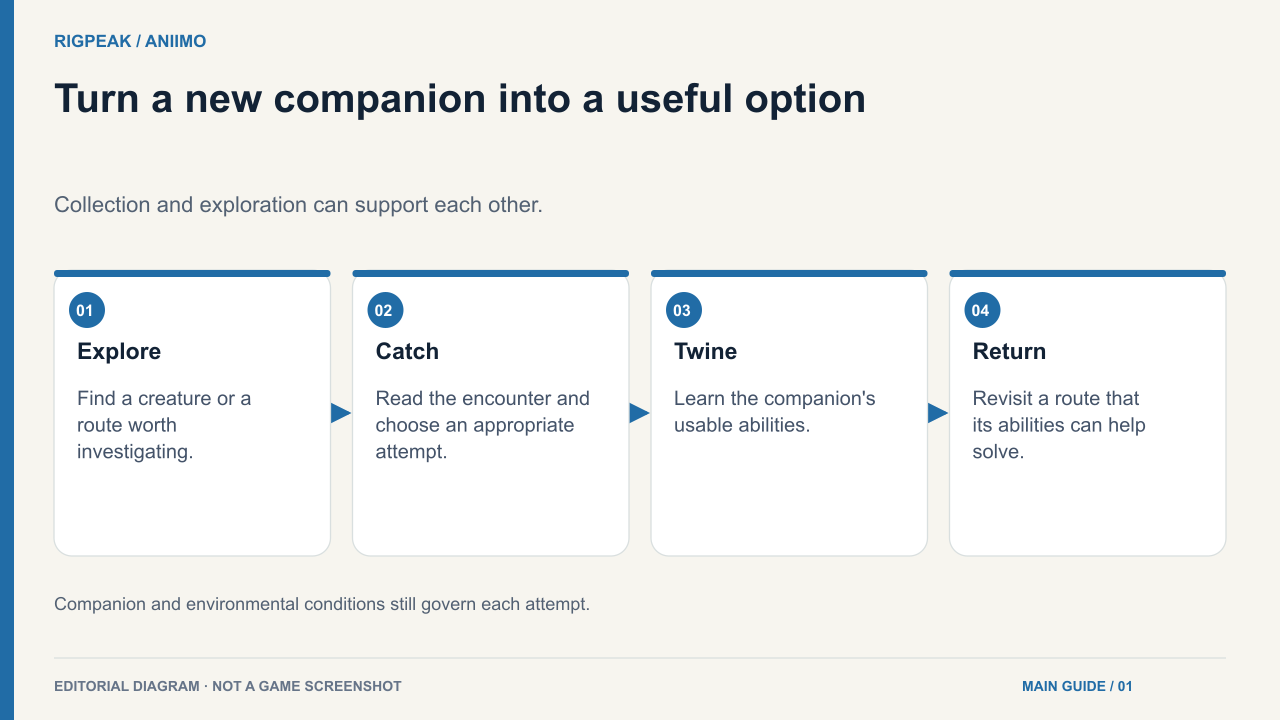
Aniimo is built around a relationship between exploration and your companions. You find creatures across Idyll, collect them and use Twining to experience the world through their abilities. A good beginning is therefore not just a bigger collection: it is a collection that lets you do more.
Follow the opening journey, learn a small set of companions and practise capturing before committing rare items to every new encounter.
Let your first journey teach you the world
Use the introductory objectives to learn movement, capture and companion management. Explore nearby points of interest, but pay attention when a route appears to require an ability you do not yet have.
Record the location or use the game's available markers, then return when you can solve the obstacle. Repeatedly trying the same approach is less useful than learning what a companion contributes.
The producer's launch introduction explains Idyll, Twining and the relationship between environment and creature encounters.
Make a capture attempt deliberate
Before using an Aniipod or another catching tool, identify the target and check the options the tutorial provides for that encounter. Different environmental conditions and creature situations can matter.
Use ordinary opportunities to practise timing and positioning. Watch whether your attempt succeeds, fails or is prevented by a condition. Then change the part you can identify, rather than throwing increasingly valuable items at an unexplained failure.
Treat catching items as a budget. Keep enough to continue the next exploration route, and inspect rewards from quests and events before deciding you must buy more.
Learn a companion's ability, not just its rarity
Open the creature's information and read what it can actually do. Separate its combat contribution from any ability that helps you move or solve a world problem.
Suppose you reach a place your current movement cannot cross. Check whether one of your companions offers the relevant traversal ability through Twining. If it does, practise the transition in a safe area before attempting the difficult route.
This turns a new catch into an immediate tool. It also gives you a reason to return to older regions with a changed team.
Build a small team with complementary uses
Start with companions you enjoy controlling and whose actions you understand. Add another when it solves a missing function: a different approach to an encounter, a useful traversal option or a support effect you can employ.
Do not divide every scarce development resource across your collection. Choose a first combat project and one or two companions whose utility remains useful during exploration.
A rare appearance, a collection entry and a stronger combat build are different rewards. Decide which one you are pursuing before spending items.
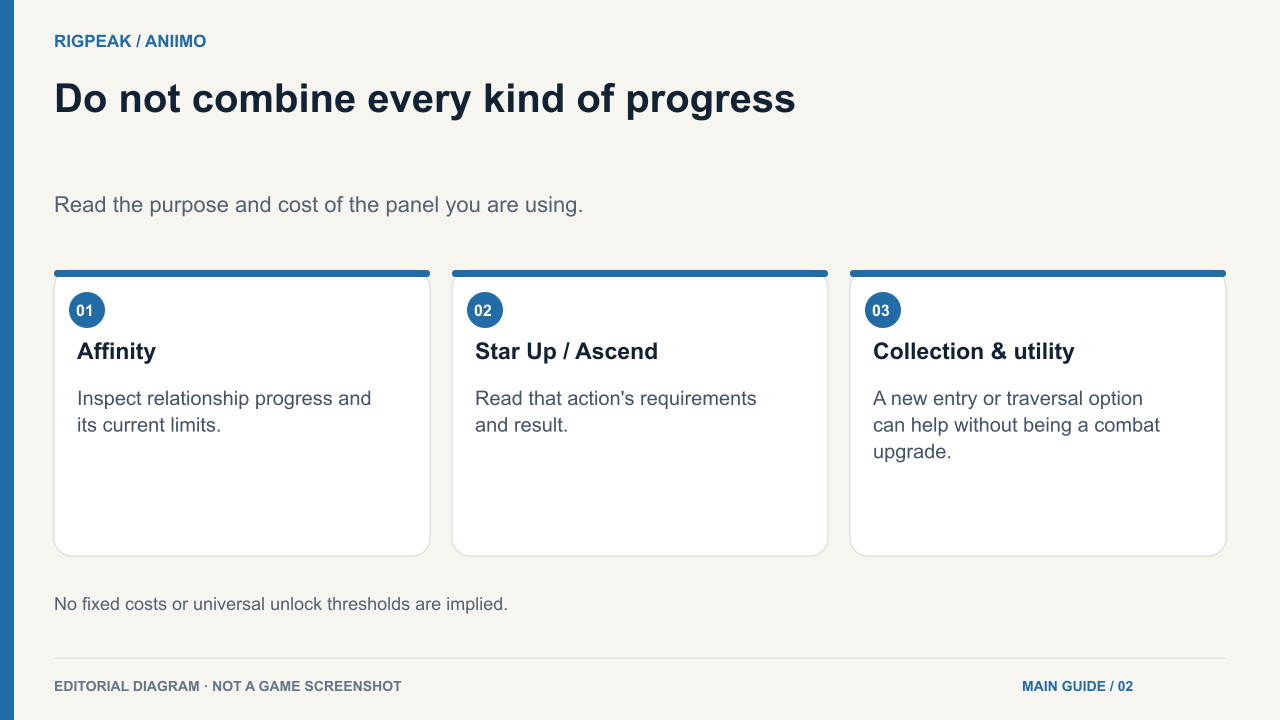
Keep Affinity separate from other development
Affinity is not simply another name for levelling or ascension. The November update describes ways to gain it and notes daily and weekly limits.
Read the current Affinity panel for the companion you are developing. If a gain stops, check those limits before assuming the activity is broken. Also inspect what the next Affinity stage unlocks rather than expecting every stage to increase the same combat stat.
When considering a Star Up or Ascend action, read that action's own materials and result. Several systems can improve the same companion without being interchangeable.
Treat Homeland and competitive activities as separate plans
Homeland provides another use for your companions and resources. Learn one function at a time, and keep its requirements separate from your next field upgrade.
Operation: Egg Heist adds a different kind of challenge from quiet exploration. Read its entry, team and reward rules before treating it as a routine farming activity. Prepare with companions you understand rather than changing the whole team immediately before entering.
The official site presents current rewards and activities. Check eligibility and deadlines on the actual event; a promotional image is not proof that a new account can claim every item immediately.
Plan one productive outing
| Before leaving | What it answers |
|---|---|
| Choose a target or area | Why you are going there |
| Check catching supplies | Whether you can use the opportunities found |
| Review companion abilities | Which obstacles and encounters you can handle |
| Keep room for discoveries | Whether you can make use of the return |
| Identify the next upgrade | What the trip is meant to support |
At the end, review what changed. You may have gained a creature, opened a route, completed a story step or learned a better way to handle a target. Each is useful progress.
You do not need to empty the map or optimise every creature immediately. Build a team that makes exploration more interesting, then develop the companions whose abilities you are actually using.