


Editorial date: September 30, 2026. First added to RigPeak: November 20, 2026. Updated November 20, 2026. This guide is based on the cited documentation and editorial analysis; it is not a hands-on test report.
Foundation: Galactic Frontier gives you a mobile headquarters and two different kinds of combat. You develop a flagship and fleet in space, then send champions into ground missions. Progress is easier to understand when you decide which layer is blocking you before spending resources.
Start by following the introductory missions and completing one useful improvement at a time. You do not need prior knowledge of Foundation's novels to understand the first steps.
Understand the role of your flagship
You play an interstellar trader in a galaxy shaped by the Empire, the Foundation and competing interests. The flagship is your operational centre, not merely another ship in a combat line-up.
Its interior development supports what you can do next. Inspect the facility or room related to your current objective, read the requirement and identify the next missing input. Avoid improving unrelated rooms simply because a notification is available.
The official FAQ explains this mobile-base structure and separates space gameplay from ground encounters.
Follow a requirement all the way to its source
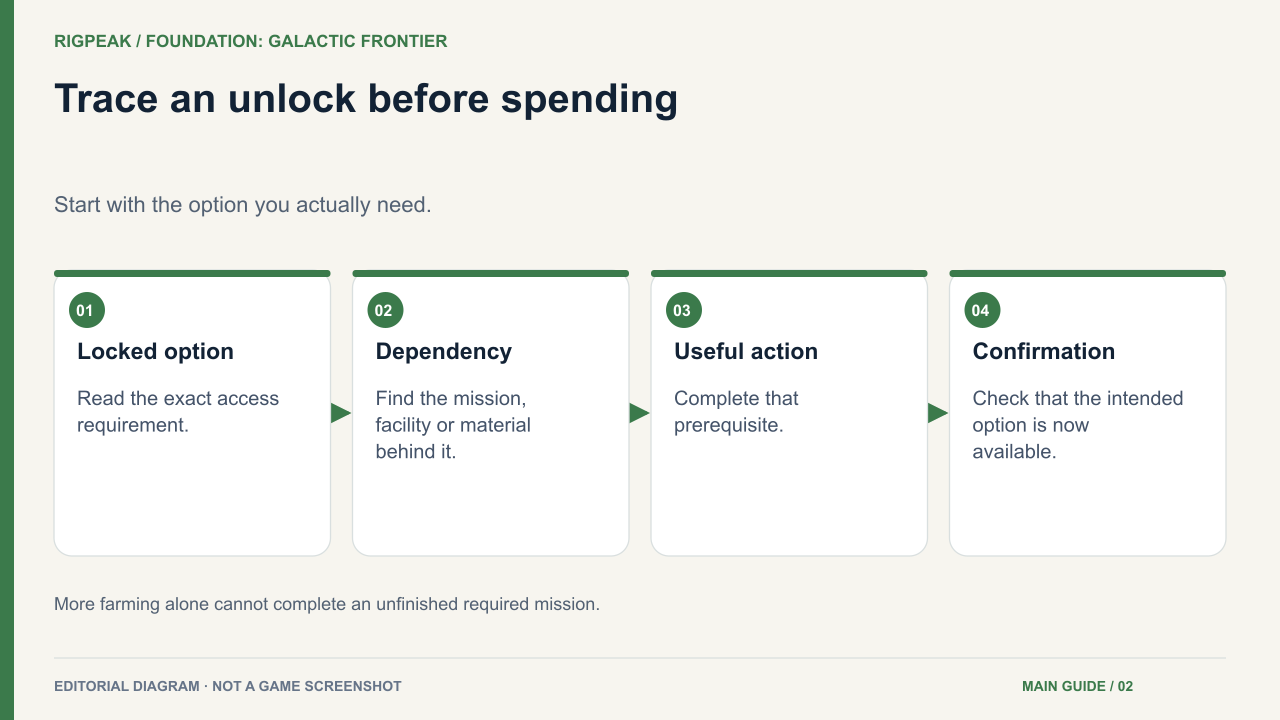
Suppose the next objective needs a stronger fleet option. Begin at the locked option and trace its requirements backward: relevant development, prerequisite and material.
If the requirement is an unfinished mission, more resource farming alone will not open it. If it is a material, check which available activity rewards it. If it is a facility improvement, complete that improvement before planning the final purchase.
This keeps your flagship from becoming a collection of upgrades with no clear purpose.
Build the ground squad for the encounter
Ground missions use a three-champion squad. Read each champion's active abilities and contribution before choosing them together.
Look for a workable balance between dealing damage, surviving the encounter and handling the specific threat. Do not assume the three highest displayed ratings produce the most reliable team.
Practise a short sequence against a familiar group: identify a dangerous enemy, use an enabling or protective ability, then focus damage. Move out of threatening attacks where the encounter allows it rather than relying on raw stats to absorb everything.
If the squad fails, first ask what happened: one champion was isolated, a dangerous enemy remained active, the team could not recover, or the damage was simply insufficient.
Treat fleet preparation as a different problem
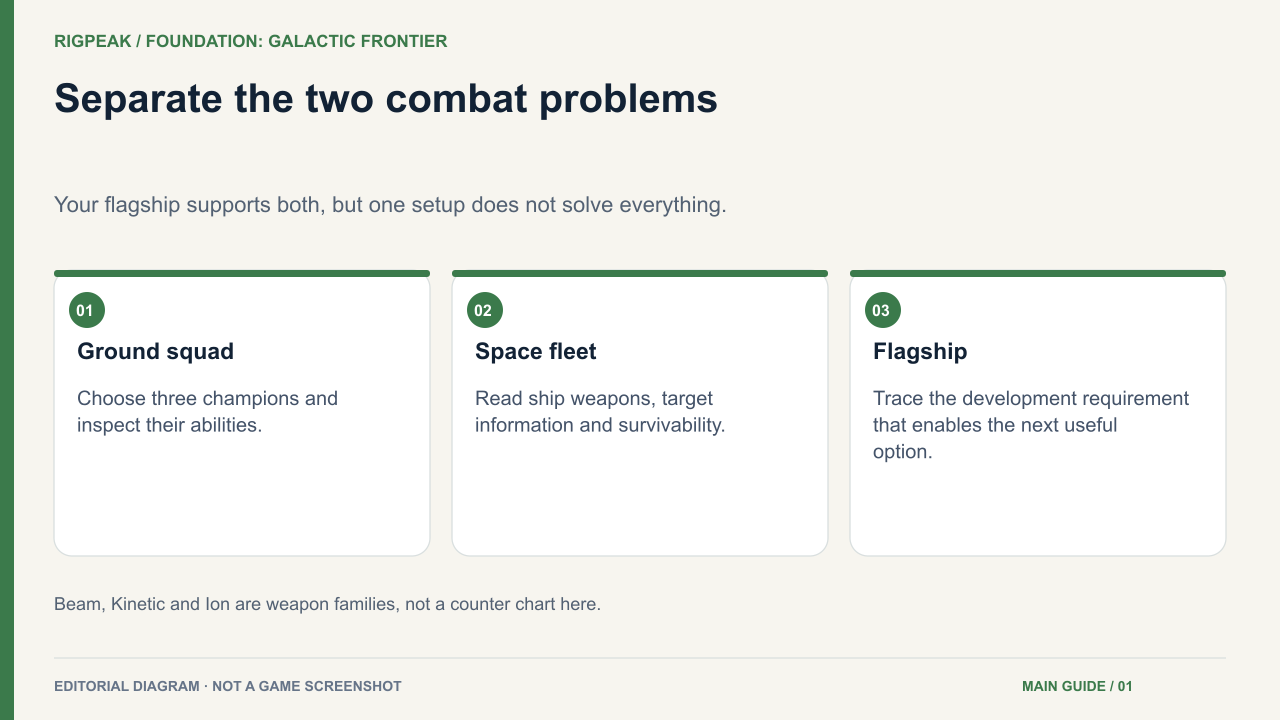
Space combat has its own weapons and tactical relationships. The official overview distinguishes Beam, Kinetic and Ion weapon families. Read the match-up and equipment information actually displayed for the target and your ships; do not infer the direction of every counter from the names alone.
Choose the fleet for the target, not for its resemblance to your ground squad. A champion who helps a surface mission does not automatically solve a fleet's weapon or survivability problem.
Before repeating a loss, inspect the battle result. A fleet that takes heavy losses immediately calls for a different investigation from one that survives but cannot finish the target.
Make one controlled improvement
Keep a simple record of the setup you tried. Change one ship, weapon choice or relevant upgrade, then compare the result against the same kind of target.
For a ground mission, use the same approach with one champion or ability sequence. Changing everything at once may produce a victory, but it will teach you little about why it worked.
| Where you are blocked | What to inspect first |
|---|---|
| An option remains locked | Mission and facility requirements |
| Ground squad loses a member early | Position, enemy pressure and protection |
| Fleet struggles against a target | Weapons, match-up and ship development |
| Resources disappear without progress | Whether upgrades support the same objective |
| An alliance activity is unavailable | Access conditions and the group's requirements |
Join a Commerce Guild with a realistic role
A Commerce Guild connects your development to shared activities and objectives. Start with a group whose communication and schedule fit you.
Read an activity's requirements before committing a fleet. Ask what contribution your current ships can make rather than assuming every operation is intended for new accounts.
The official FAQ describes cooperation around routes, ports and larger conflicts. That does not mean every member needs the same fleet or should spend toward an advanced target immediately.
Keep purchases separate from your learning plan
The game offers optional purchases that can include progression benefits. Before considering one, identify the problem it would solve.
If you do not yet know whether a loss comes from the squad, the fleet or a locked development requirement, buying resources may simply make that uncertainty more expensive. Read the current item's contents and conditions rather than relying on a general statement about value.
Finish a session with a clear next step
Choose a mission, identify its actual blocker and complete one part of the solution. Then leave the flagship organised for the next session.
Your first useful milestone is not a particular power total. It is understanding how a flagship improvement supports a fleet or squad that can complete a repeatable mission. Build that connection before chasing every newly unlocked system.