


Editorial date: October 3, 2026. First added to RigPeak: November 20, 2026. Updated November 20, 2026. This guide is based on the cited documentation and editorial analysis; it is not a hands-on test report.
Genshin Impact is easier to begin when you connect exploration to a small team's needs. Story quests open the journey, the world supplies materials and combat rewards understanding elemental interactions. You do not have to develop every character or reach the newest region immediately.
Start with a team you can support, learn one reaction and keep your next upgrade specific.
Follow the opening while exploring nearby
Progress the introductory story and the functions it introduces. Activate useful travel points, investigate nearby chests and puzzles, and gather materials along the routes you already use.
If an activity is locked, read its requirement. Account Adventure Rank, World Level and an individual character's level are different systems. A quest condition cannot always be solved by making one character stronger.
When a fight begins to feel harder after progression, inspect the whole team's development before pushing farther into the same difficulty.
Learn a reaction through a controlled example
Characters apply elements in different ways. Read a skill and observe the element on an enemy before switching to the next action.
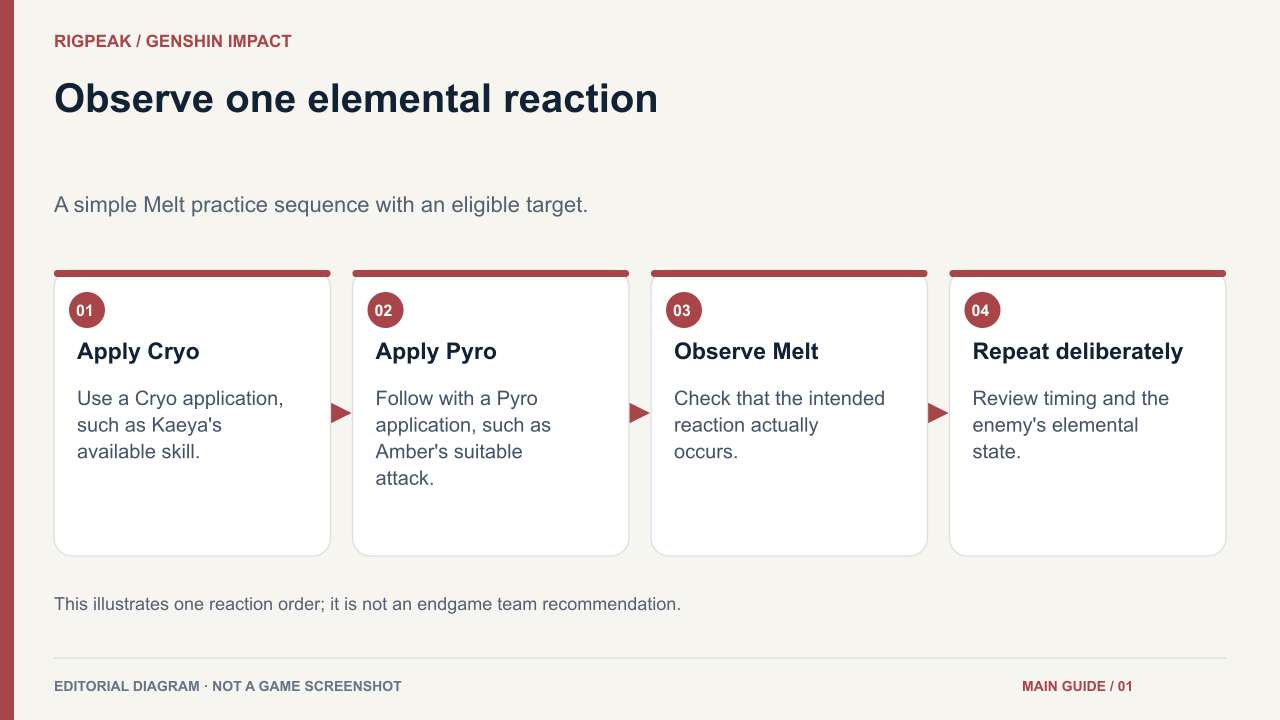
A simple early exercise is to apply Cryo and then Pyro to a suitable ordinary enemy, creating Melt. The KQM reaction reference explains this interaction. With the familiar introductory characters, Kaeya and Amber can demonstrate the idea once you have access to their relevant attacks. The point is to see the application and reaction, not to build an endgame rotation around that exact pair.
The developer's game description introduces the elemental system. Reactions have different rules; do not assume every pair produces the same kind of extra damage.
Give your first team a few clear jobs
Choose one main source of reliable damage, characters whose skills support the intended interaction and a way to stay alive. A character can fill more than one role.
Read whether an effect persists after switching. A support whose contribution remains active can let another character use the field time. On the other hand, a skill that needs the character to remain on field changes how you sequence the team.
Practise against the same kind of enemy. Use the enabling skill, switch to the character who benefits and observe whether the intended reaction occurs. If it does not, check application, timing and enemy properties before replacing the team.
Improve weapons and characters with a purpose
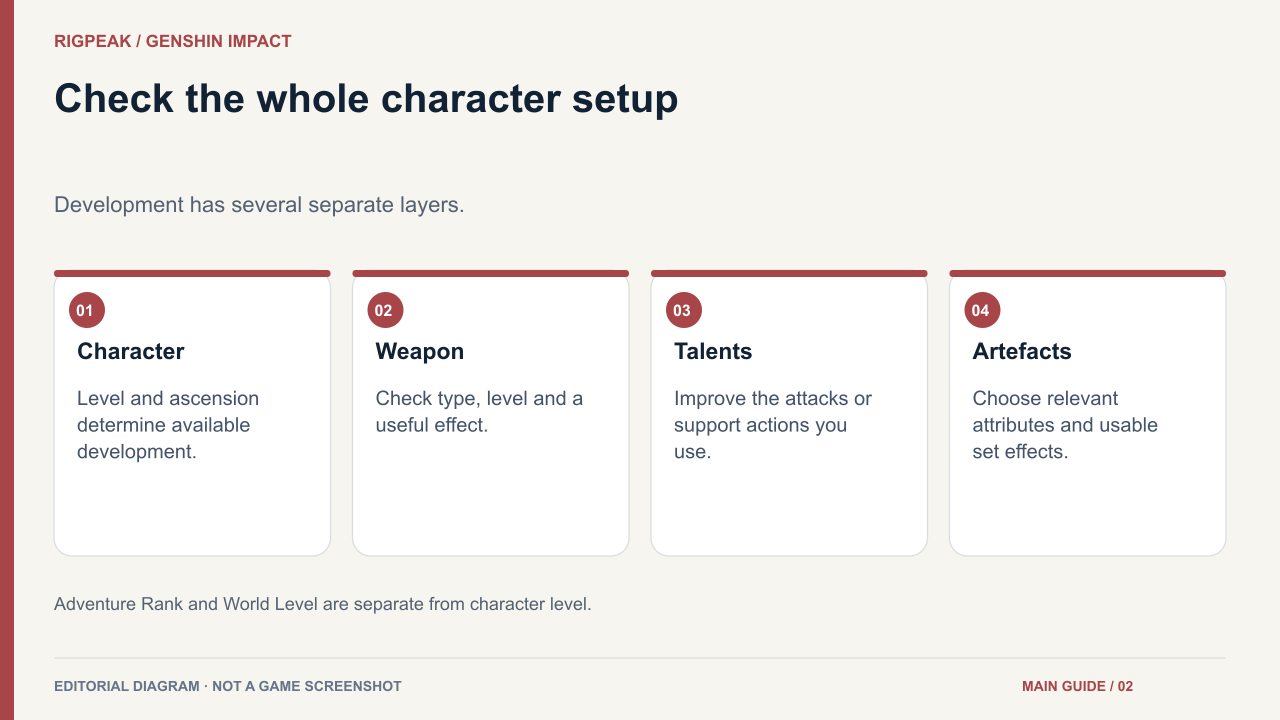
When resources are limited, develop the characters you actually use together. Check weapon level, character progression, relevant talents and equipped artefacts rather than focusing only on the rarity of a new item.
An artefact's main stat and useful substats matter. A completed set made from unsuitable pieces may not help your immediate job. Early on, a coherent and affordable setup is more useful than trying to reproduce a finished specialist build.
Before ascending a character or weapon, open the requirement and identify the missing material. Trace that material to the activity or location that actually provides it.
Spend Resin to solve a shortage
Original Resin is a progression resource, not a reason to enter any available challenge at random. Decide what you need, check the reward source and choose a difficulty your team can clear reliably.
Avoid a rigid farming rule copied from an old guide. The game's systems and costs have changed over time; the Luna I update details are one example of why old resource values need checking.
Save consumable refills until you know what the extra runs will achieve. You do not need to spend them merely because a guide says a daily session should be longer.
Diagnose a difficult encounter
| What happens? | What to inspect |
|---|---|
| You survive but deal little damage | Weapon development, reaction setup and enemy resistance |
| A character falls during the opening | Defence, recovery, positioning and attack timing |
| Bursts are rarely available | Energy generation and the skills used in the sequence |
| The team repeatedly interrupts its own plan | Which character needs field time and for how long |
| A required upgrade seems unavailable | Account access, activity schedule and the exact material |
Specialist references such as KeqingMains are most useful after you can describe the character's job. Read their assumptions about teammates, weapons and rotations; do not copy the finished numbers without the setup.
Explore without turning the map into a chore
Choose one region or route for a session. Use a quest as an anchor, then follow nearby puzzles and discoveries that interest you. Mark an obstacle you cannot yet solve and return later.
Cooperative activities have their own restrictions and progression conditions. Confirm the particular activity before arranging to complete it with friends.
For recruitment, distinguish the banner, its currency, featured rewards and guarantee rules. A new character may offer another playstyle, but it is not the default solution to an unexplained combat failure.
Your first strong account is a team with maintained equipment, a reaction you can produce deliberately and a clear source for its next materials. That gives you room to explore Teyvat at your own pace.