

Editorial date: October 12, 2026. First added to RigPeak: November 20, 2026. Updated November 20, 2026. This guide is based on the cited documentation and editorial analysis; it is not a hands-on test report.
A NIKKE squad can contain strong individual characters and still struggle if its Burst sequence breaks. Your first priority is a team that can operate together through more than one wave. Once that works, better aim, target selection and focused investment become much more effective.
Start with campaign battles you can observe closely. A narrow defeat is useful when you can identify what failed.
1. Check Burst coverage before rarity
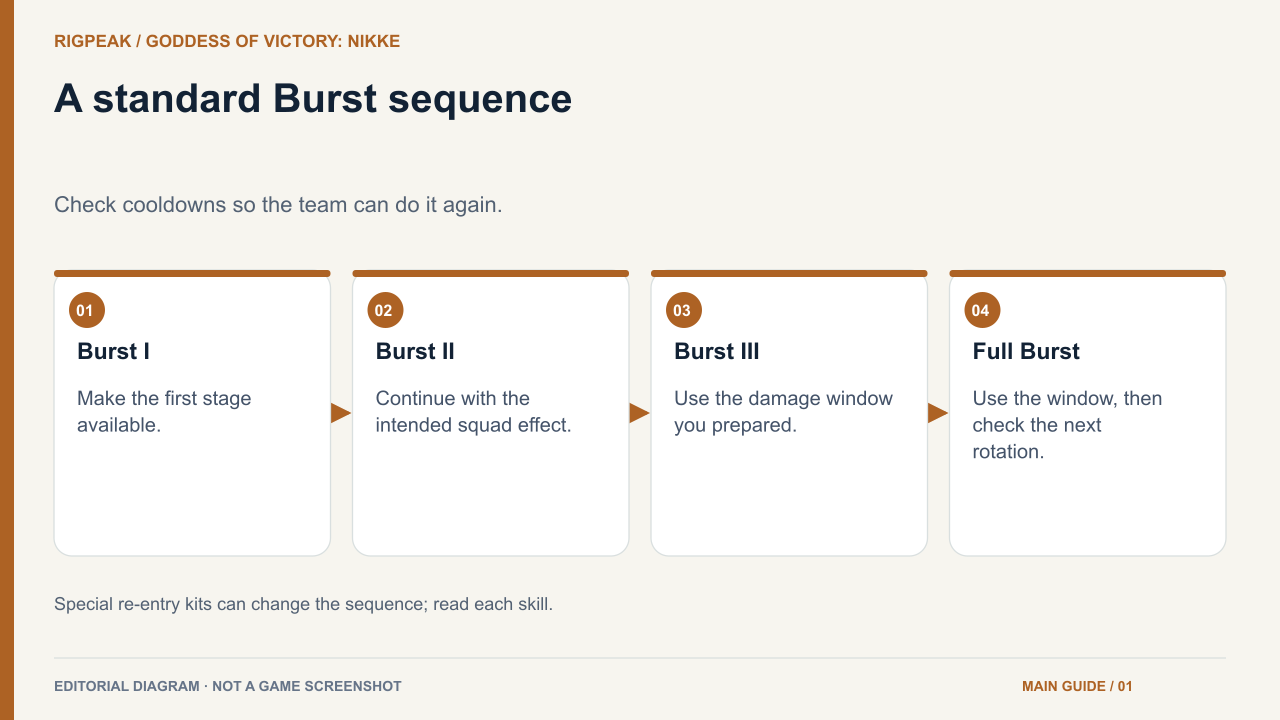
Open each Nikke's skill panel and identify her Burst stage, cooldown and any special activation rule. For a conventional rotation, the squad moves through Burst I, Burst II and Burst III to reach Full Burst.
Check the second rotation as well as the first. A stage covered by one character with a longer cooldown may not be ready when the other members are. Some kits re-enter a Burst stage or otherwise alter the standard sequence, so read the individual description. Prydwen's team-building guidance explains why stage coverage and timing must be considered together.
Make a small roster note:
| Member | What to record |
|---|---|
| Burst I option | Cooldown and any repeated-stage requirement |
| Burst II option | Cooldown and squad benefit |
| Burst III options | Which one you intend to use in each rotation |
| Remaining slot | Damage, healing or another specific need |
The fifth slot should solve a problem. Another attractive portrait is not a role.
2. Run a two-rotation practice fight
Enter a familiar encounter and watch the Burst buttons. Trigger the planned first sequence, then look at what is available for the next one.
If the chain stops, find the missing stage. If the necessary character has died, you have a survival problem. If she is alive but unavailable, revisit cooldown coverage. Those failures can look similar during a busy battle but require different changes.
Once manual activation makes sense, test automatic Burst. Confirm that it chooses the order you intended. Adjust formation order or control the sequence manually when a character-specific condition demands it.
Do not replace a functioning squad with a nominally stronger one until you have checked that the new lineup still cycles.
3. Use cover and target priority to protect the rotation
Nikkes fight from fixed positions and alternate between firing and taking cover. Cover can be damaged and destroyed; it is not permanent invulnerability. Prydwen's beginner guide describes these controls and the difference between individual and squad cover.
Practice the cover command before attempting a difficult boss. Watch the enemy's attack cue, stop firing when appropriate, then resume when the dangerous moment has passed. Check the battle's control settings if the command is unfamiliar.
Prioritize enemies that threaten to end the run: an imminent attack, a dangerous projectile or a target tied to the objective. Spending all your fire on a large, durable enemy while a smaller one defeats your Burst support can be an expensive mistake.
Against a boss, observe which parts or indicators the encounter presents. Learn one mechanic at a time instead of changing the entire team after every failure.
4. Use synchronization to avoid leveling the whole roster separately
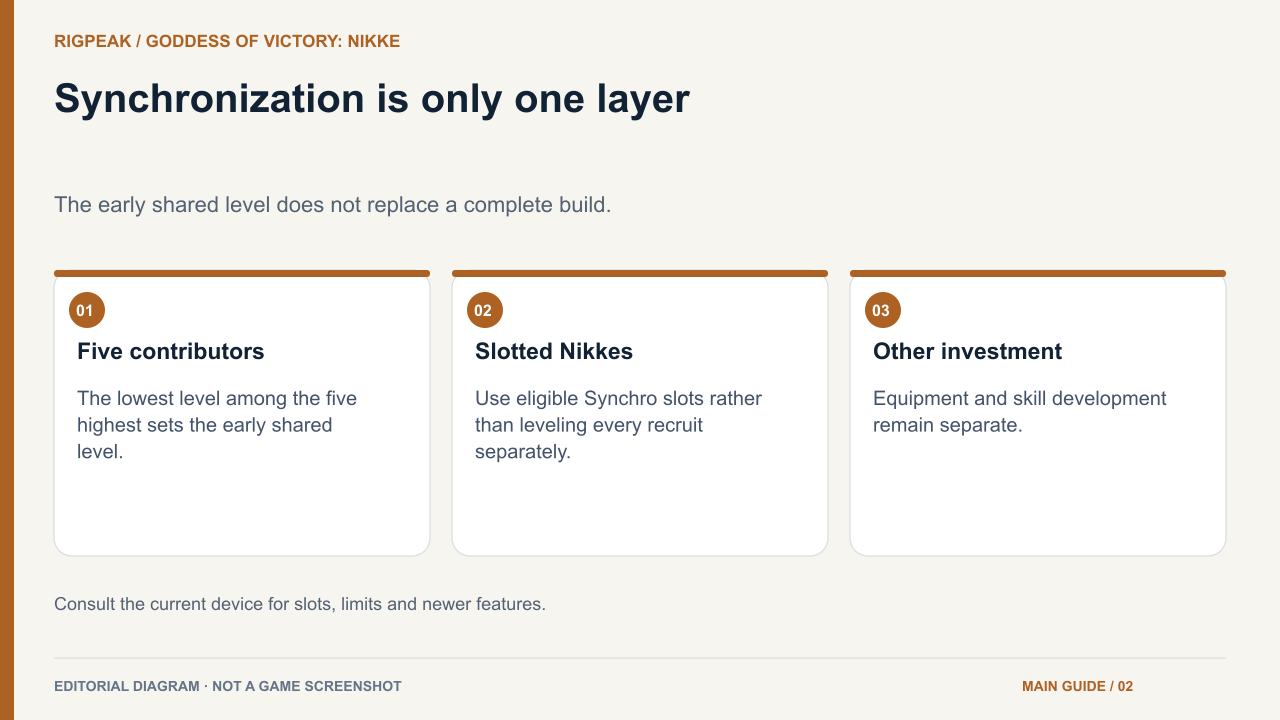
The early Synchro Device uses the lowest level among your five highest-level Nikkes as the level shared with characters placed in its slots. This makes the development of that contributing group important. Nikke.gg's synchronization explanation documents the basic relationship; consult your current device panel for available slots and newer features.
For example, raising four contributors while leaving the fifth far behind can leave the shared level behind too. Check which five the device actually counts before spending more materials.
Synchronization does not mean every character has the same equipment or skill investment. Inspect those systems separately. Do not assume a level reset refunds every other resource used on a character.
5. Match progression activities to the shortage
Campaign progress, equipment and skill development work together. When stuck, identify the missing part before collecting unrelated rewards.
- If your rotation breaks, repair team coverage or protect the necessary member.
- If the squad survives but the timer expires, inspect damage, target priority and offensive development.
- If characters fall early, review cover use, equipment and recovery.
- If a level increase is unavailable, read the exact material or limit requirement.
The game's character progression systems include levels, skills and equipment, but old numerical thresholds should not replace the live upgrade panel.
Use skill materials on characters and skills whose role you understand. Level synchronization alone is not a reason to invest heavily in every new Nikke.
6. Review before recruiting
When a recruitment option looks appealing, decide what gap it fills. Does your squad lack a reliable stage in its rotation, survival support or damage suited to a particular fight?
Read that banner's current rules, duration and guarantees before using currency. A new character may offer a different team project rather than an immediate repair for your existing squad.
You have a solid early foundation when your team completes repeated Burst sequences, you recognize the attacks that require cover and you can connect your next upgrade to a specific campaign obstacle.