
Editorial date: October 18, 2026. First added to RigPeak: November 20, 2026. Updated November 20, 2026. This guide is based on the cited documentation and editorial analysis; it is not a hands-on test report.
Sea of Conquest combines a developing flagship, a collection of heroes and battles across a pirate world. Your first task is to make those systems work together. A stronger ship, a better-developed hero and a successful voyage are related, but they are not the same kind of progress.
Begin with the story route, identify the next flagship requirement and prepare a crew for activities you can already complete.
Follow the first route before expanding every system
Introductory objectives give your early voyages a purpose and open functions in a manageable order. When a feature is unavailable, inspect the condition instead of assuming a higher power number will unlock it.
Take a moment at each new port or menu to identify what changed. Is it a new destination, a room, a ship option, a hero activity or an alliance function? Knowing the category helps you choose the next action.
The official game description distinguishes flagship development, naval combat and hero-based activities.
Improve the flagship for an immediate need
Open the improvement you want and read its prerequisites. Work backward to the room, resource or earlier upgrade that actually blocks it.
Do not upgrade every visible room equally without considering its purpose. A facility that supports your current production or access requirement may be more useful than an unrelated improvement.
Before using speedups, check that completing the timer will leave you with the resources needed for the next step. Otherwise you may simply trade a timer for a resource shortage.
Match heroes to their assigned job
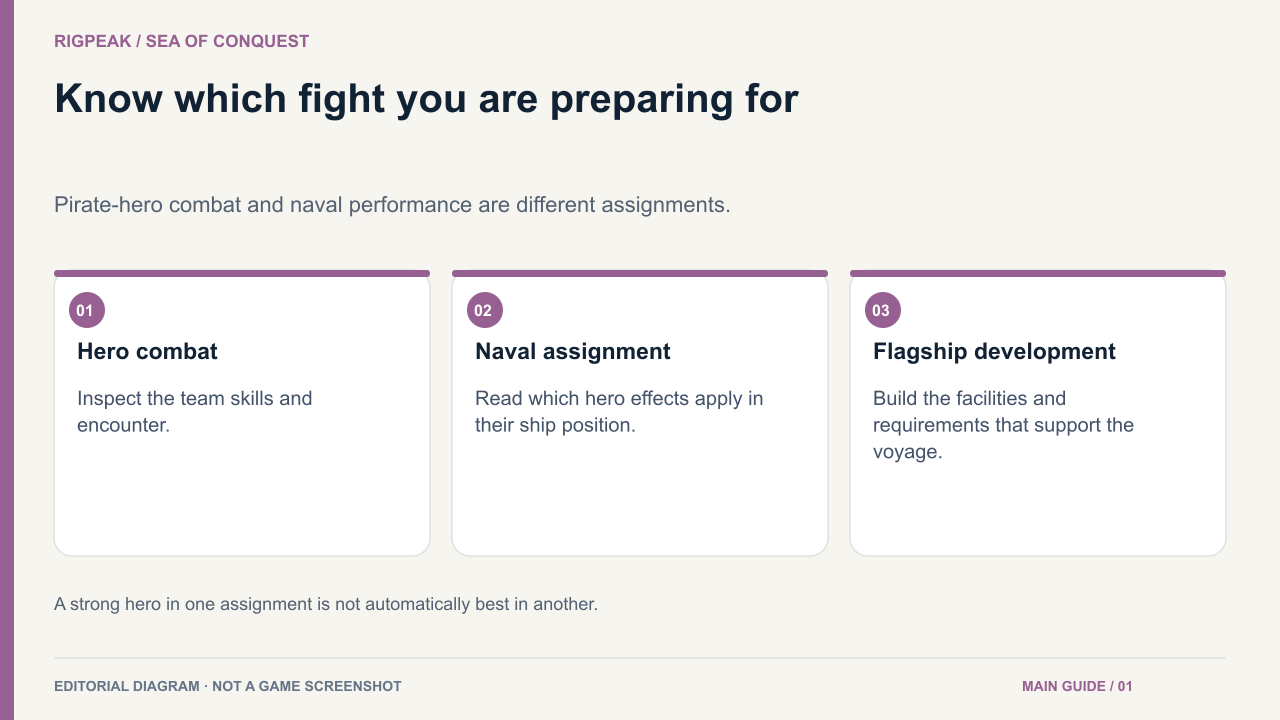
Read the ability and assignment information for the heroes you already have. A hero's value depends on what you ask them to do and whether their effect is active in that position.
Keep naval assignments distinct from hero-only encounters. A successful hero team in an activity does not prove that the same arrangement is the best crew for every ship.
For a first setup, choose complementary contributions you can identify. Prefer a modest team with understood skills over a collection of rare portraits whose effects do not support one another.
Prepare a voyage before leaving
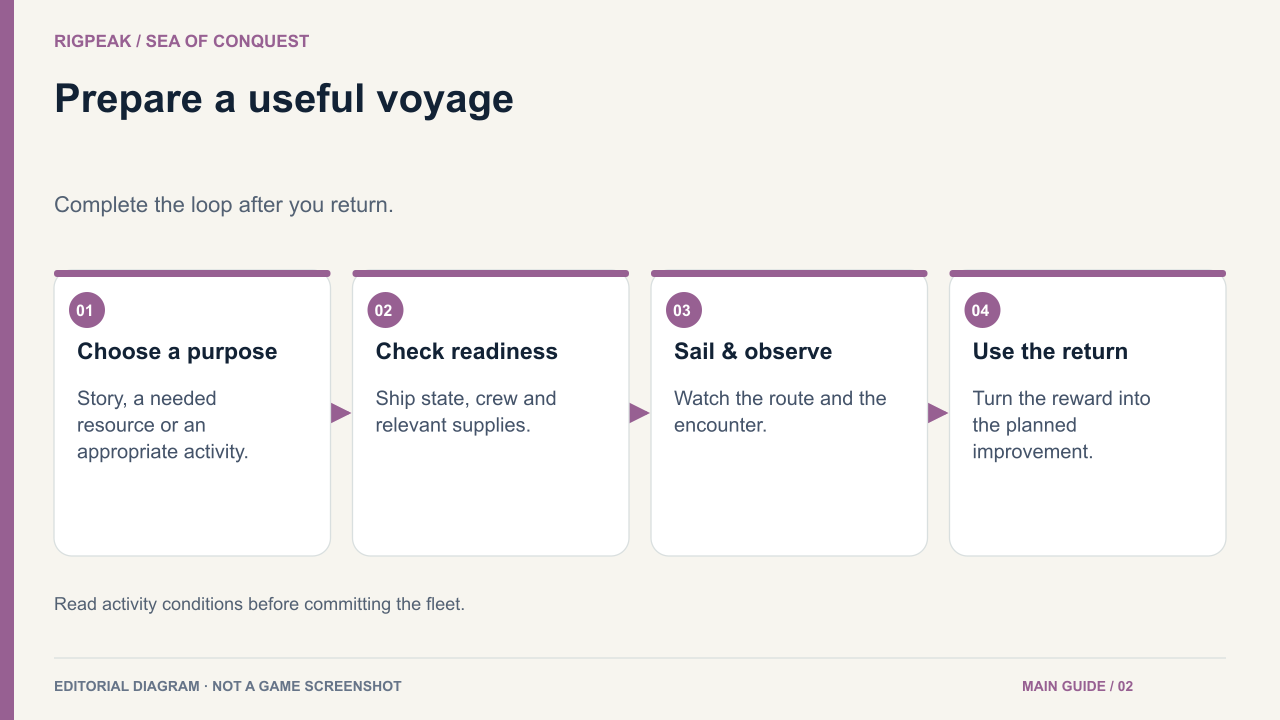
Choose the destination and the reason for going there. You might need a mission objective, a specific reward or progress toward the next development requirement.
Check the ships and crew you are sending. Read the target information and make sure the force is in usable condition. Do not assume that every nearby enemy belongs to the same difficulty.
After the encounter, inspect what you gained and what restoring the fleet requires. A route that repeatedly creates expensive recovery can be a poor routine even if you sometimes win.
Turn one result into one improvement
Suppose a naval encounter is consistently difficult. First check that the assigned heroes' effects apply to the ships and situation. Then look at ship development and the target itself.
If a hero activity is the problem, assess that team's skills and sequence instead. The distinction prevents spending on the wrong system.
| Blockage | First place to look |
|---|---|
| Flagship upgrade is locked | Its displayed prerequisite chain |
| Naval force performs poorly | Ship condition, assignments and target |
| Hero team loses quickly | Role balance and skills for that encounter |
| A new destination is unavailable | Story, access or development requirement |
| Resources are constantly short | Whether voyages reward what you actually need |
Use the same type of encounter for comparison after changing one meaningful part of the setup.
Learn recipes from the current recipe system
Cooking and related orders can provide another reason to collect resources. Use the recipe information available in your version and check the order's requested result.
Do not consume valuable ingredients by following an unverified old combination. If a recipe has not been established, treat an experiment as an experiment and budget ingredients accordingly.
Similarly, confirm whether a displayed event reward is available to your account and season. An attractive reward in a promotion is not a reason to neglect the requirements of your regular progression.
Join a gang with a role you can support
The social game includes coordinated objectives and activities. Choose a group whose schedule and communication suit you, then ask which contributions are useful at your stage.
Read the event and participation rules before committing a fleet. Some shared objectives reward coordination more than a single player's attempt to do everything.
Keep personal development and gang priorities connected: a resource or upgrade is easier to justify when it helps you perform a real role.
End with an organised flagship
Return, review the outcome, arrange the next development step and identify the next voyage's purpose. Keep heroes assigned deliberately and avoid leaving several resource-heavy projects half complete.
Once you can connect a flagship requirement to the voyage and crew that solve it, the wider map becomes a set of choices rather than a wall of notifications.