


Editorial date: October 28, 2026. First added to RigPeak: November 20, 2026. Updated November 20, 2026. This guide is based on the cited documentation and editorial analysis; it is not a hands-on test report.
Three Kingdoms: Strategy for the World is easier to understand when you think beyond your own army. A march needs a destination, a supply plan and a purpose within the alliance's operation. Your profession helps determine how you contribute.
This guide follows the Traditional Chinese edition, 三國:謀定天下, presented on the official regional site. English role descriptions below are explanations, not a claim that every region uses those exact English class names.
1. Choose a profession around the work you will do
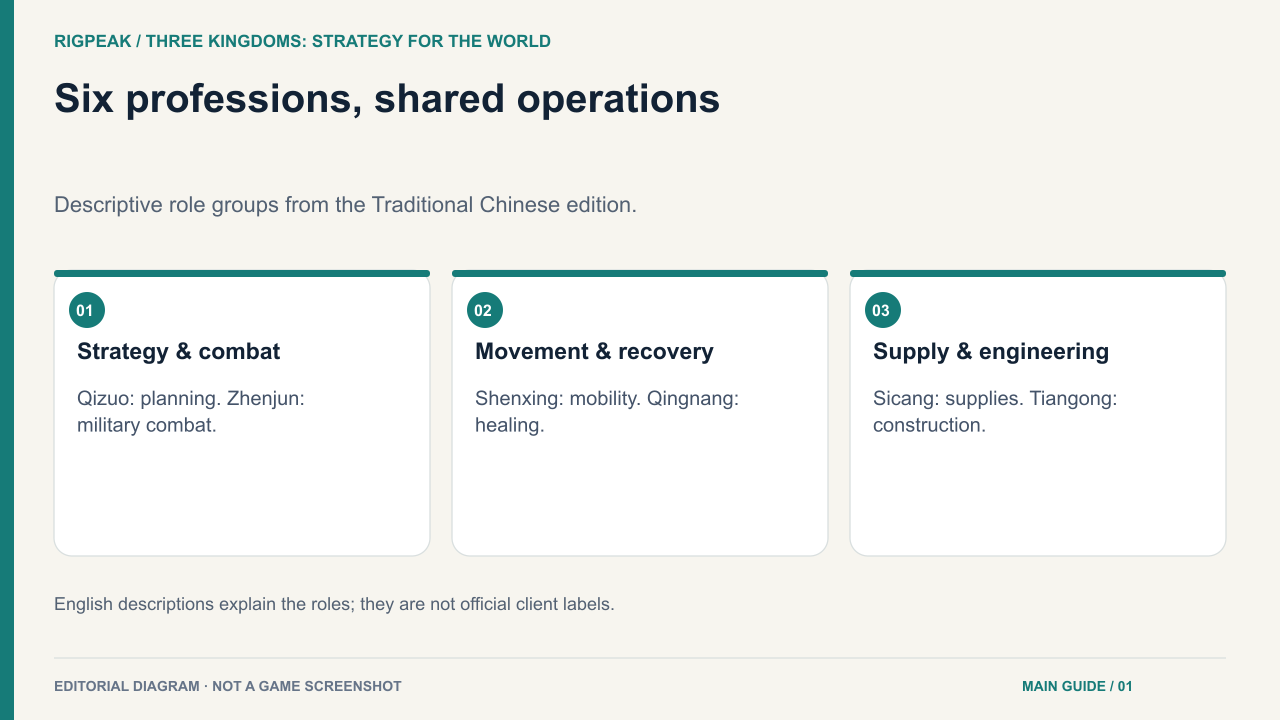
The official site identifies six professions. Their broad identities give you a starting point:
| Profession | Descriptive English role |
|---|---|
| 奇佐 | Strategy and tactical planning |
| 鎮軍 | Military combat |
| 神行 | Mobility and unconventional movement |
| 青囊 | Healing and recovery |
| 司倉 | Supplies and development |
| 天工 | Engineering and battlefield construction |
Open the profession's current skills before selecting it. Find out what you can activate, where it applies and what resource or timing condition limits it.
Discuss the choice with your alliance if you already have one. A profession that fills an actual need gives you a clearer job than one chosen from a solo power ranking. Also consider your availability: coordinated battlefield work is easier when you can be present for the operation.
Check change conditions before committing. Do not assume you can freely switch whenever an alliance needs something different.
2. Learn your season and local objectives
Identify the server, season and starting area. Read the active objectives and the alliance's development instructions before spending heavily.
Use the opening tasks to learn territory access, formation management and resource collection. Progress toward one useful near-term goal: a functioning march, access to a planned route or preparation for a shared objective.
Avoid copying a season-specific build without checking its assumptions. A formation may depend on generals, tactics or rules that your current account does not have.
Keep a simple record of what your next goal needs. This makes it easier to distinguish a shortage you can solve today from an unlock that requires later progress.
3. Assemble a formation with compatible functions
Read each available general's abilities and the conditions attached to them. Look for a coherent plan: how the formation deals damage, how it remains effective under attack and how its tactics support one another.
Check placement and troop information in the current interface. A powerful individual does not guarantee an effective formation when its required conditions are missing.
Practice against an appropriate PvE target. Examine the result rather than judging only by victory. Did the formation take losses you cannot sustain? Did the effects you expected activate? Was the target suitable for its development?
Improve one weakness, then repeat a comparable fight. That is more useful than rebuilding the entire formation after every report.
4. Trace the supply route before the attack
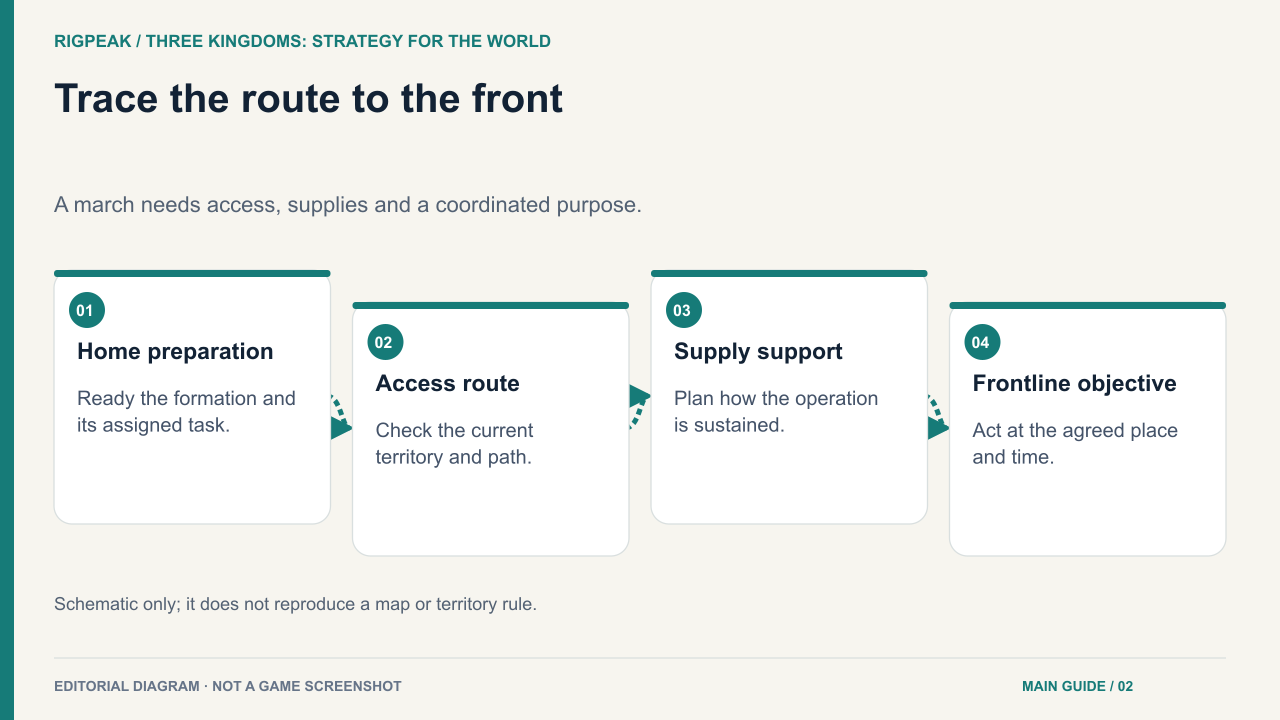
Logistics are an explicit part of the game: the regional description connects transport routes and supplies to frontline operations. A distant objective should therefore begin with a map check.
Establish the destination, accessible route, supply support and intended return or recovery point. Confirm that the path still makes sense at the operation's start; a plan drawn earlier can become unsuitable when territory changes.
For example, an army may be ready while the route that supports it is not. Moving early can leave it exposed without advancing the alliance's objective. The correct preparation may be protecting or establishing the route rather than adding another attacking march.
Do not improvise a separate target because it is nearby. Splitting effort can leave both attacks weaker.
5. Use profession skills at an agreed moment
A profession ability is useful when it supports the operation's timing. Ask what event should trigger its use and who needs to know when it is available.
Engineering, movement, supplies and recovery can influence different parts of the same action. Coordinate them as a sequence rather than activating every skill as soon as it becomes ready.
Report completion clearly: the route is prepared, the support action is used or the formation needs recovery. Specific information lets the next player act.
The official description also emphasizes shared city development. After a conquest, check the alliance's follow-up instructions; capturing a location is not necessarily the end of its strategic value.
6. Read losses before ordering another march
After a battle, compare the formation, target, support and route with the plan. Identify whether the problem was a matchup, a development gap, poor timing or missing logistics.
Estimate whether another attempt is sustainable before committing the same resources again. If the situation has not changed, repeating the order may only repeat the loss.
A useful first week leaves you with a profession you understand, a formation you can explain and an alliance role you can perform reliably. That foundation matters more than appearing at every battle with no clear assignment.