Editorial date: November 8, 2026. First added to RigPeak: November 20, 2026. Updated November 20, 2026. This guide is based on the cited documentation and editorial analysis; it is not a hands-on test report.
World of Tanks rewards decisions made before you fire: where you stop, what can see you and whether you have a way back to cover. Your first goal is to stay useful long enough to influence a battle.
This guide covers World of Tanks on PC. Start with Bootcamp, then learn one vehicle's strengths before racing up a research branch.
1. Turn the tutorial into a repeatable routine
Complete Bootcamp and explore the Garage it introduces. Find your vehicle's characteristics, ammunition, consumables, crew and research screen. The official getting-started guide explains these entry points.
Before each battle, check ammunition and resupply settings. Read the selected mode's objective. Winning does not always mean chasing the last visible target; a base or other objective can decide the match.
For your first battles, choose a simple learning target: fire from cover, watch the minimap after each shot and avoid crossing open ground without a reason. Repeat those habits until they become automatic.
2. Choose a position with an exit
At the start, look at where teammates are going and which approaches your vehicle can support. Avoid being the only tank advancing into an unknown lane.
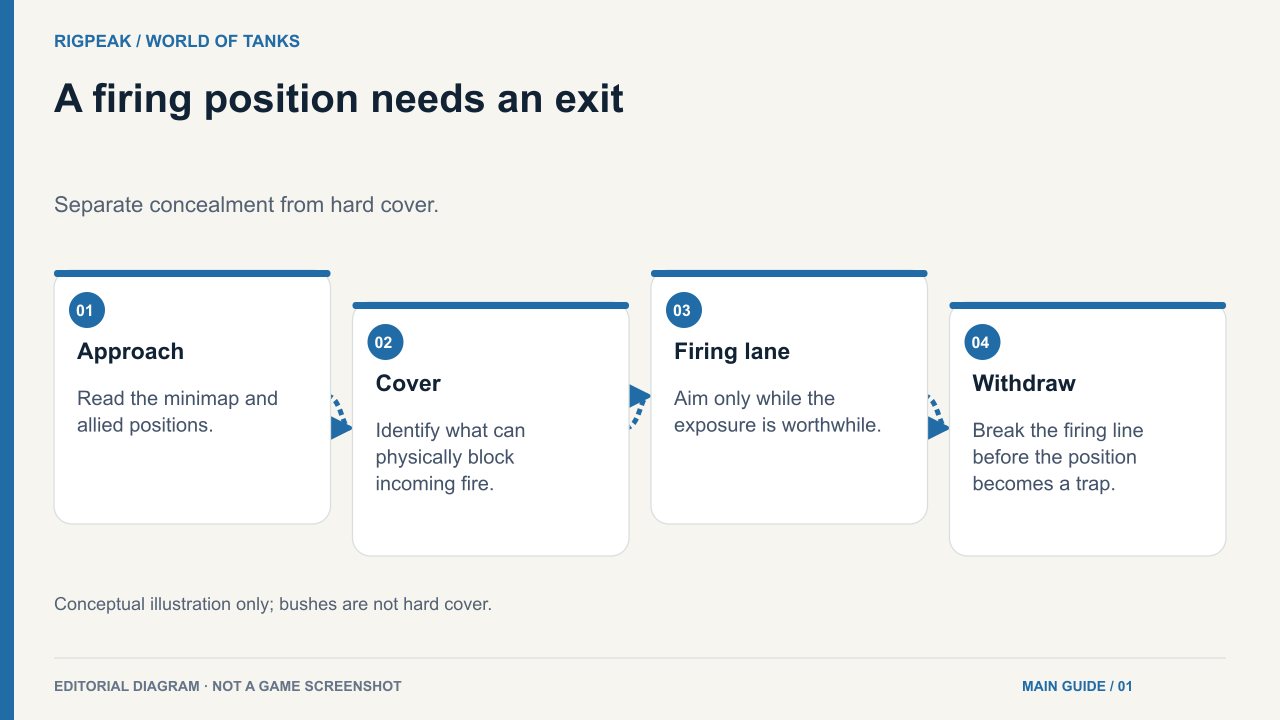
Before stopping to aim, identify nearby hard cover and the direction from which an enemy could shoot you. A rock or building can block a shot; a bush primarily helps concealment. Those are different forms of protection.
After firing, return behind cover when exposed. Do not remain in the open merely to watch whether your shell lands. If enemies gain a second firing angle, reassess the position before it becomes a trap.
Preserving hit points does not mean hiding at the back for the entire match. It means spending them deliberately when the action helps your team.
3. Understand why an unseen tank can still hit you
Spotting is a core system, separate from whether you personally notice a tank on the screen. Vehicle characteristics, concealment and shared information all affect the picture you receive.
Enable useful minimap view-range indicators and learn what they represent. The official survival guide explains spotting, foliage and the warning that your vehicle has been detected.
Treat that warning as a reason to consider incoming fire. Break the firing line or reposition when possible. A tank disappearing from view may still be close enough to threaten you.
Firing can reduce concealment. Before shooting from foliage, consider whether revealing your position is worth the shot. A scout that stays alive and provides information can be more useful than one that fires once and is immediately destroyed.
4. Aim for a penetrable target
Allow the aiming circle to settle when the situation gives you time. Look for a useful angle rather than repeatedly shooting the strongest surface you can see.
Armor effectiveness depends on the target, impact angle and ammunition. Use the Garage's armor inspection tools to study a troublesome opponent. Test your own vehicle too: learn which parts should stay hidden instead of assuming the whole tank is equally protected.
Inspect the ammunition your gun actually carries. Special ammunition has a cost and different behavior; loading it does not solve poor aim or an unsuitable angle. The official upgrade guide explains shell and module categories.
If the shot is unreliable and the enemy is watching you, relocating may be better than repeatedly trading damage.
5. Match your play to your particular vehicle
Vehicle categories suggest a starting role, but individual tanks differ. Compare armor layout, mobility, gun depression, reload and view range.
A tank with a strong turret may benefit from terrain that hides its hull. A mobile vehicle can support a changing flank, but speed does not make a solo charge safe. A vehicle built around a fixed gun needs room and time to bring that gun to bear.
Practice a small number of vehicles long enough to recognize their limits. After a defeat, ask whether the position suited the tank before blaming its statistics.
6. Research, purchase and mount separately
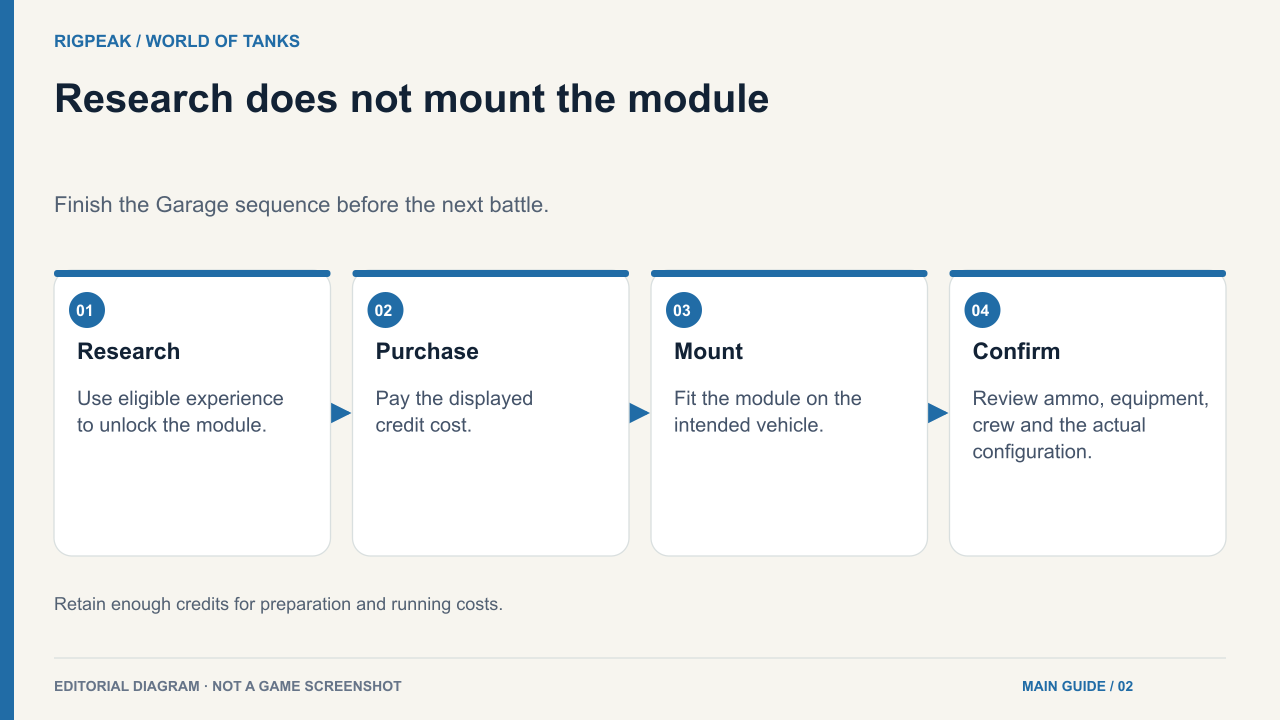
Experience unlocks development; credits pay for purchases and running costs. Researching a module does not automatically mean it is installed.
Open the research screen, inspect dependencies, research the desired module, then purchase and mount it. Confirm the equipped configuration afterward. The official economy guide distinguishes credits from experience.
Keep enough credits for ammunition, repairs and useful equipment. Moving to the next vehicle without funds to prepare it can make the new tier frustrating.
Check crew and equipment transfer conditions before selling the old tank. Do not make irreversible inventory decisions simply to clear space.
7. Review the decision that ended your battle
Use the results and replay, when available, to find the first avoidable problem: an unsupported push, an exposed reload, an ignored flank or shots that could not penetrate.
Choose one correction for the next match. When you survive longer while still spotting, dealing damage or protecting an objective, your fundamentals are improving—even before your vehicle collection grows.